
How to Build Real Motivation for Fitness (When Consistency Has Been Hard)
Starting a fitness routine is one thing; following through when life is busy, your mood shifts, or results feel slow is the real challenge. We will talk about building genuine motivation for a fitness routine—especially if you’ve tried before and drifted away.
The aim isn’t to “get disciplined overnight,” but to create conditions that make movement feel doable, meaningful, and repeatable.
The quick version you can actually use
Motivation grows when your plan fits your real life, not your ideal life. Pick a small “minimum routine” you can do even on rough days, then build upward slowly. Use your environment (clothes, schedule, location, reminders) to reduce friction, and treat missed days as feedback—not failure.
Why motivation keeps vanishing – and what it’s trying to tell you
When people say they “lack motivation,” it’s often one of these issues:
- The goal is too abstract (“get fit”), so your brain can’t act on it today.
- The plan is too expensive (time, energy, travel, social pressure).
- Confidence is low because past attempts ended in guilt.
- The routine fights your environment (no space, no privacy, no predictable window).
- The reward is delayed (health and physique changes take time).
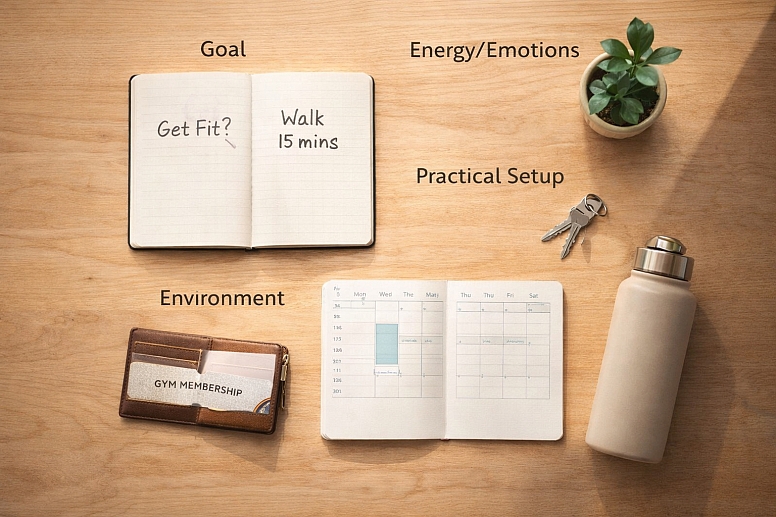
Motivation is not just a feeling. It’s a system: expectations + emotions + practical setup. If any part is unstable, follow-through becomes shaky.
A small table of common traps (and better replacements)
|
If your routine is… |
It often leads to… |
Try this instead |
|
“All-or-nothing” (5 days/week or nothing) |
Quitting after a missed week |
A minimum routine (10 minutes counts) |
|
Built around punishment |
Avoidance and resentment |
A focus on capacity (energy, strength, mobility) |
|
Too complicated |
Decision fatigue |
One simple plan repeated for 2–4 weeks |
|
Measured only by appearance |
Frustration |
Track inputs (sessions done, steps, sleep) |
Don’t forget to hydrate
When it comes to fitness, the importance of hydrating cannot be overstated. It can affect energy levels, exercise comfort, and how well you recover afterwards. Many people underestimate how quickly mild dehydration can make things feel harder than it needs to be. One easy habit is to keep water within reach before and after you train—especially if you’re active in warm weather or doing longer sessions. It’s also wise to drink a glass of water right after waking up.
Make your environment do some of the work
A routine survives when it has fewer obstacles than excuses. Small changes matter:
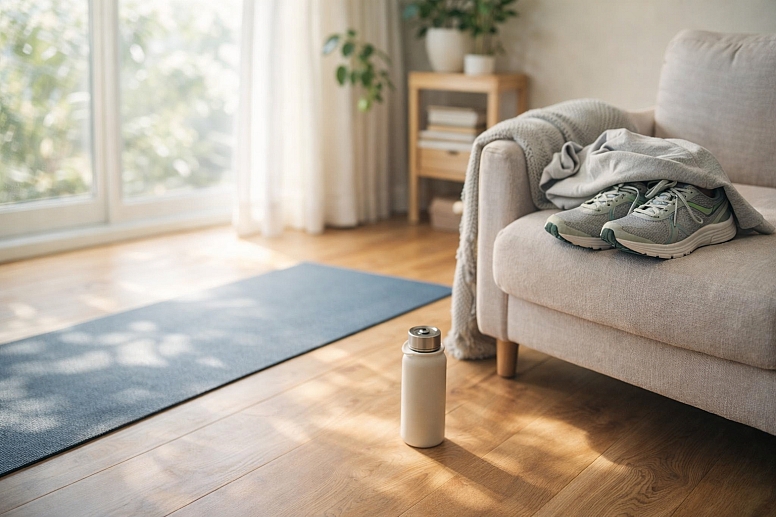
- Keep workout clothes visible (not buried).
- Choose a route or location that feels safe and convenient.
- Reduce “activation energy”: a mat, a resistance band, or a simple plan on your phone.
- If social support helps, invite someone—but keep your routine viable without them too.
Your environment is a silent partner. Set it up to nudge you forward.
A solid beginner-friendly resource (if you want structure)
If you’d like a guided plan that removes a lot of decision-making, the NHS Couch to 5K programme is a widely used beginner running plan that gradually builds you up in manageable steps. It’s designed for people starting from scratch, which can make it less intimidating than generic training advice. Even if running isn’t your end goal, the structure is a helpful example of progressive overload without overwhelm.
FAQ
How long does it take to feel motivated?
Often, motivation follows action. Many people notice improved mood and energy after consistent movement, but the reliable driver is your system (cue + minimum routine), not waiting for inspiration.
What if I hate the gym?
You don’t need a gym. Walking, cycling, home strength training, dance, swimming, or sports all count as physical activity.
How do I set goals without burning out?
Use two layers: a process goal (e.g., 3 sessions/week) and a direction goal (e.g., improved stamina). Track what you can control: sessions completed, minutes moved, or workouts repeated.
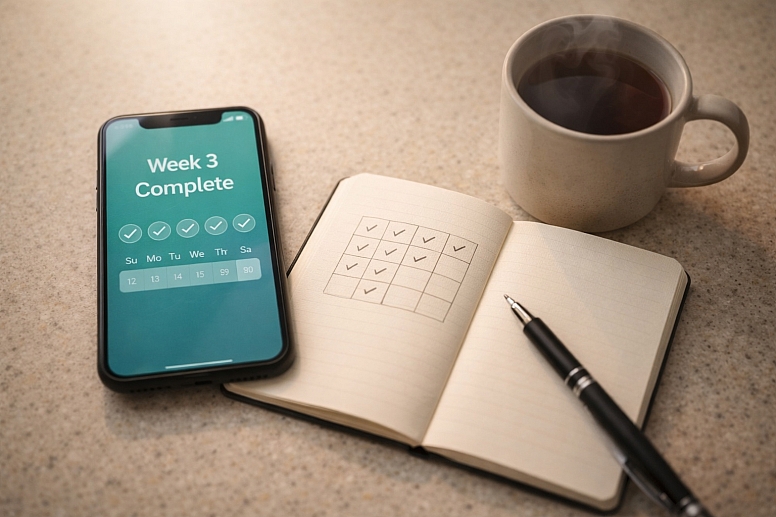
I keep restarting. How do I stop the cycle?
Shrink the restart. Your next “start” should be so small it doesn’t require a dramatic personality change—then build gradually.
Real motivation is built, not found: it comes from small wins, clear cues, and a plan that survives imperfect weeks. Start with a minimum routine, protect your self-trust, and make your environment supportive. As consistency grows, confidence usually follows. And once confidence is there, motivation stops feeling like a rare event—and starts feeling like a habit.
LEAVE A COMMENT
Categories
Recent Posts





0.0668